

Min. to Max. Annual Precipitation
24in.
Average Max. Height
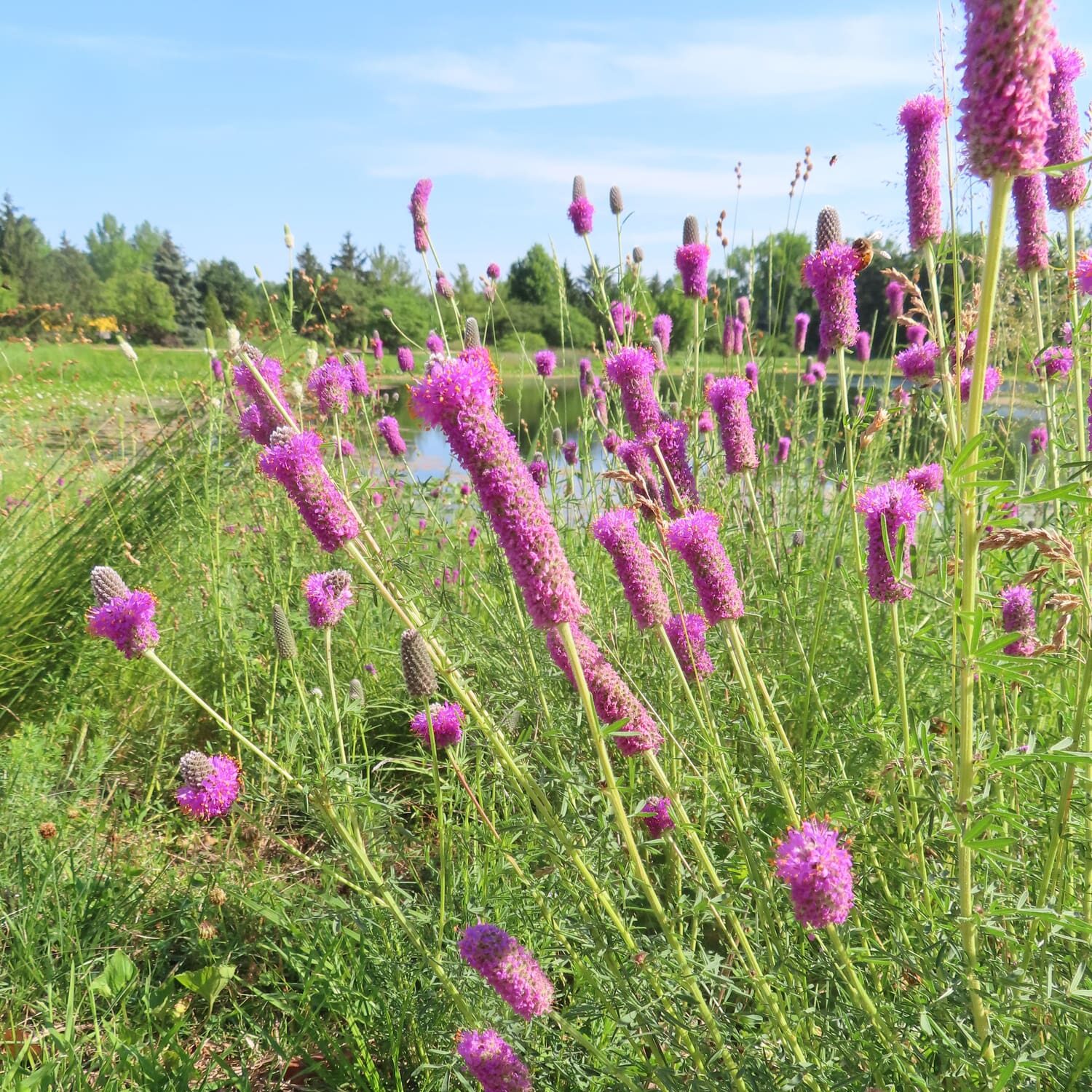
Purple Prairie Clover (Dalea purpurea) is a legume that grows about 12-24″ tall. It is drought tolerant due to its deep root system needing only 14-18″ annual precipitation. It performs best in well drained soils and full sun areas. It takes about 3 years to begin blooming fully. Best time to plant is late fall or early spring.
For quick plant facts please click on the “Quick Plant Facts” tab.
General Description:
Purple Prairie Clover (Dalea purpurea) is a member of the legume family which is native to North America and is perennial and herbaceous. The plant has an erect type growth habit that typically grows from 12 to 24 inches tall. The first flowers to bloom are located at the base of the spike with the circle of flowers moving upward along the spike as new buds bloom and old flowers fade. The flower petals, which are rose-purple with projecting gold-orange anthers, are small and simple compared to other typical legume flowers. The plant is deep rooted with a 6 foot tap root that has 3 to 7 lateral roots located within a foot of the soils surface.
Purple prairie clover has a thimble-shaped flower arrangement which blooms from the bottom to the top. These purple flowers do not have a noticeable floral scent, but the flowers attract a number of pollinators. Even after the flowers are done blooming, it remains very attractive due to its ornamental foliage.
Common name: Kaneb Purple Prairie Clover
Previously called Petalostemum purpureum.
Uses:
Purple prairie clover is used for native prairie restoration and re-vegetation of natural areas. It produces excellent forage quality for livestock, but its overall production is not very high. It can cause bloat in cattle, but is high in protein which increases its forage quality.
Planting Conditions:
Make sure to clear any existing weed growth to avoid competition as Dalea purpurea is not overly competitive.
This plant is not picky when it comes to the soil characteristics, as long as the site is well-drained. Typical habitats include black soils, prairies, sand prairies, savannas, and limestone glades. Purple Prairie Clover has a deep taproot that ensures it will last in any native planting. It can be planted in the spring, on bare soil, and will germinate without overwintering. Purple Prairie Clover needs full sun.
Don’t plant deeper than 1/4 inch. If planted too deep it won’t emerge.
Establishment:
Best time to plant is Late fall / early winter. The natural cold stratification helps with germination but is not needed to germinate. Even though Purple Prairie Clover is drought tolerant it still needs moisture to allow germination. Avoid soil from crusting or long dry spells until the roots have had a chance to develop deeper.
Year one is spent developing the root system so there is not much above ground growth happening.
Year two flowers begin showing and the foliage increases
Year three you will see full bloom, and a strong presence and with it being a long lived perennial it will last several years.
Seeding Rate:
5 pounds per acre

PURPLE PRAIRIE CLOVER
(Dalea purpurea)
Purple Prairie Clover NRCS Plant Guide and Fact Sheet
Purple Prairie Clover NRCS Plant Guide and Fact Sheet
PDF version of NRCS Plant Guide & Fact Sheet
Citation: USDA-Natural Resources Conservation
Service, Manhattan PMC. Manhattan, KS 66502.
Published [March 2013]
Who is Great Basin Seed?
Great Basin Seed is a seed company that specializes in seed sales and consultation for home, ranch, farm, range and reclamation. We have been a leader in the seed industry since 1974.
Our History
We've been in the seed business since 1974.
What We Offer
We offer seed for home, farm, ranch, range and reclamation projects.
Meet the Gang
We have the best employees in the world! We are proud of the work they do, and trust them to serve you!
Right: Company founder Lloyd and his wife Paula Stevens in a wildflower seed production field circa 1977
Quick Plant Facts
| Common Name: | Purple Prairie Clover |
|---|---|
| Scientific Name: | |
| Select a Package Size and Quantity | 1 oz. Envelope, 4 oz. Pouch (0.25 lbs.), 8 oz. Pouch (0.50 lbs.), 1 lb. (by the pound) |
| Root Form: | |
| Drought Tolerance | Limited Drought Tolerant (14 – 18 inches annual precip.) |
| Growth Height: | |
| Lifespan: | |
| Origin: | |
| pH Tolerance: | |
| Plant Type: | |
| Seeds per Pound: | |
| Max Sowing Depth: | |
| Best Time to Sow: | |
| Planting Rate: | |
| Plant Height: | |
| Elevation of Occurance: | |
| Sun & Shade Tolerance: | Full sun, Partial shade |